
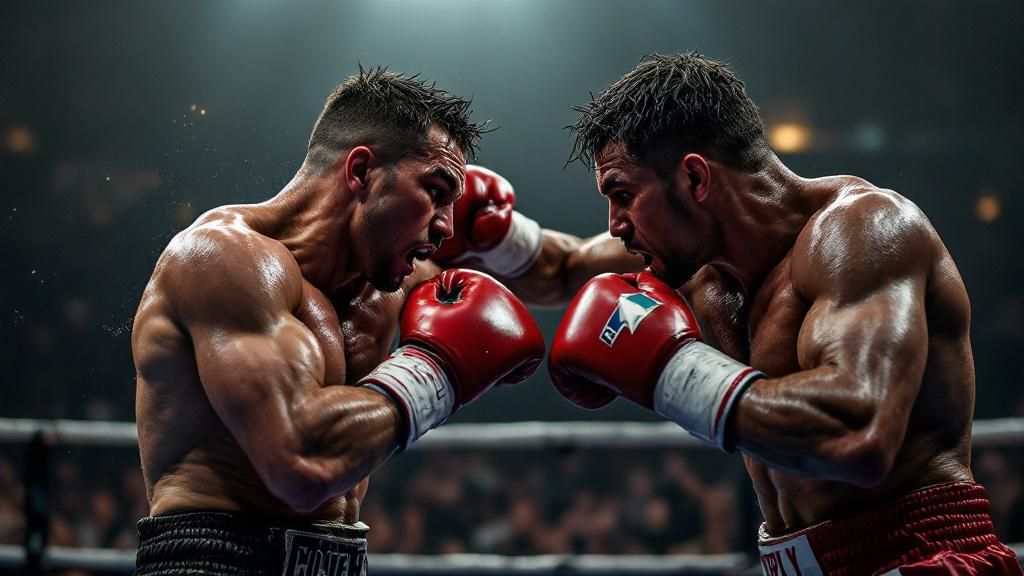
Belfast’s Anthony Cacace has won his second world title in a gruelling encounter at Dublin’s 3 Arena, landing the WBA super-featherweight title with a unanimous decision victory over defending champion James ‘Jazza’ Dickens. The 37-year-old, who previously held the IBF title before vacating it last year, triumphed on cards of 116-113, 116-112 and 115-113 in a cagey bout that failed to ignite before a capacity crowd. Cacace’s win establishes he stays firmly in the conversation amongst the division’s top fighters, alongside Mexico’s Emanuel Navarrete and American O’Shaquie Foster, who hold the remaining major titles at super-featherweight. The triumph marks another milestone in a remarkable resurgence for the Northern Irish fighter.
A Gruelling Clash for Super-Featherweight Championship
The contest at Dublin’s 3 Arena proved a technical, cagey affair that seldom ignited, with both fighters displaying considerable respect for each other’s skillset across all twelve rounds. Dickens, the reigning title holder from Liverpool, employed his left-handed style to create difficulties for Cacace, repeatedly shifting in and out whilst targeting the body with accuracy. The veteran fighter had secured a best win of his career over Albert Batyrgaziev just the previous summer and travelled to Ireland with significant self-belief, yet found himself unable to deliver the knockout shots needed to keep his title against a composed opponent.
Cacace, meanwhile, showcased the kind of controlled strategy that has defined his recent renaissance, content to work behind his jab and time Dickens as the champion sought to close distance. The Belfast fighter turned up the intensity noticeably from the fifth round onwards, driving his opponent backwards and introducing his uppercut into the combination work. Despite the lack of explosive exchanges, Cacace’s consistency and ring control ultimately persuaded all three judges to give him the win, with the closest card reflecting just how tightly fought this battle for super-featherweight supremacy had been.
- Dickens employed awkward southpaw style throughout the contest
- Cacace stepped up the pace markedly after the fifth round
- Both fighters displayed considerable mutual respect throughout the bout
- The bout failed to ignite in spite of championship-level stakes
Cacace’s Technical Skill Dominates
Initial Exchanges and Tactical Adjustments
The opening rounds saw Cacace settle into a rhythm behind his jab, systematically attempting to time Dickens as the Liverpool champion operated smoothly in and out of range. The southpaw puzzle presented a real challenge for the Belfast challenger, who found himself occasionally caught by sharp counters as Dickens targeted the body with clinical precision. However, Cacace resisted being pulled into a frantic exchange, instead keeping his discipline and gradually building a foundation upon which to construct his assault. His willingness to occasionally switch to a southpaw stance himself demonstrated the tactical flexibility he has developed throughout his career resurgence.
By the fourth round, the contest had established a pattern of mutual respect, with both combatants clearly aware of the other’s strengths and unwilling to over-commit. Dickens seemed satisfied to keep range, perhaps hoping to draw Cacace into injudicious moves that could be capitalised on, yet the challenger declined to be drawn in. Instead, Cacace persisted with his measured approach, utilising the straight punch and biding his time for opportunities to land the heavier shots. This strategic discipline would eventually prove conclusive, as adjudicators acknowledged his dominant ring control and consistency across the early exchanges despite the absence of dramatic action.
The Critical Juncture in Round Five
The fifth round signalled a significant change in momentum as Cacace visibly increased his attacking intensity, letting out an audible growl of intent as he pressed ahead with renewed purpose. Driving Dickens backwards across the ring, the challenger started incorporating his uppercut into combination work with greater frequency, forcing the champion on the defensive for the opening occasion in the contest. This aggressive burst appeared to unsettle Dickens, who appeared to sense the accumulated pressure of Cacace’s relentless attack. The Belfast fighter’s willingness to take the initiative at this critical moment demonstrated his ring craft and championship pedigree, capitalising on the moment when the contest hung in the balance.
From this juncture onwards, Cacace never released his newly acquired control, maintaining his forward momentum through the remaining rounds whilst persistently delivering the cleaner, more consistent shots. Dickens attempted to respond with a more front-foot approach in the latter stages, yet these efforts came too late to reverse the deficit he had accumulated. The defending champion’s own fight assessment acknowledged that his strategic changes in the final rounds simply proved insufficient to preserve his crown. Cacace’s capacity to identify the moment and take advantage of it demonstrated precisely why he merits recognition amongst the elite fighters in the division.
- Cacace’s jab created control throughout the early exchanges consistently
- Fifth round pressure became the decisive turning point of the contest
- Dickens’ closing adjustments couldn’t surmount accumulated deficit
Dickens’ Left-Handed Problem Comes Up Short
James Dickens came to Dublin as the defending WBA super-featherweight champion, bringing the confidence of a fighter who had orchestrated one of his best career victories against Albert Batyrgaziev only a few months earlier. The Liverpool southpaw presented a puzzle that Cacace had not faced since their respective paths last crossed in 2015, and the champion opened proceedings with real threat, immediately targeting the challenger’s body with deliberate focus. Yet for all Dickens’ technical ability and the difficult angles afforded by his southpaw stance, he struggled to maintain the initial dominance he had built. Cacace’s better fight control and ability to adapt his approach gradually neutralised the threat created by the champion’s unconventional style.
Dickens’ efforts to move in and out of range, evading Cacace’s attacks and maintaining just enough space to prevent sustained exchanges, ultimately turned out to be an insufficient formula for success. The titleholder appeared satisfied to frustrate his challenger during the opening exchanges, but this cautious strategy rendered him vulnerable to the narrative of the bout shifting clearly in Cacace’s favour. When the Belfast man seized the upper hand in the fifth round, Dickens was playing catch-up for the remainder of the contest. His belated strategic changes in the closing rounds, whilst more forceful than his earlier approach, came much too late to overcome the growing gap. The scorecards reflected Cacace’s greater consistency and dominance throughout twelve gruelling rounds.
| Round | Key Moment |
|---|---|
| Round Two | Dickens lands solid counter as Cacace seeks to time the champion on the way in |
| Round Three | Cacace enjoys late success with flush right hand landing cleanly on the champion |
| Round Four | Cagey exchanges with both fighters respectful of each other’s capabilities |
| Round Five | Cacace surges forward with renewed aggression, driving Dickens backwards across the ring |
Future Prospects for Each Fighter
Cacace Pursues Greater Prospects
With his second global championship now confirmed, Cacace has established himself solidly amongst the top tier of the super-featherweight division. The Belfast boxer’s win against Dickens strengthens his claim to recognition as one of the division’s leading contenders, though he stands as one of three title holders at 59kg. Unification fights against Mexico’s Emanuel Navarrete, who holds both the WBO and IBF belts, or America’s O’Shaquie Foster, the WBC champion, represent the natural progression for Cacace’s career. At 37 years old, the opportunity for major fights stays available, and his performance in Dublin suggests he possesses the quality needed to perform at the top of the sport.
Cacace’s profile has grown substantially after his controlled display versus a battle-hardened challenger in an opposing venue. Manager Frank Warren and his Queensberry outfit will undoubtedly be exploring avenues to secure the biggest and most prestigious matchups on offer. A unification clash would represent the pinnacle of Cacace’s professional journey, providing the prospect to emerge as an undisputed champion and solidify his legacy in the sport. Whether talks with Navarrete or Foster progress quickly is unclear, but Cacace’s latest performances and track record to deliver in difficult circumstances suggest he warrants a place in negotiations.
Dickens Confronts an Unpredictable Path
For Dickens, the loss in Dublin constitutes a major blow in what had been a successful career path. The 34-year-old Liverpool fighter had entered the contest as the reigning WBA title holder, yet his tactical approach ultimately proved insufficient against Cacace’s superior ring generalship. Dickens’ left-handed style, which had worked effectively in previous encounters, did not produce the expected dividends against an opponent prepared to adjust and impose his will. The defeat raises questions about whether Dickens possesses the calibre required to compete at the highest level of the super-featherweight division.
Dickens’ post-fight remarks suggested a philosophical acceptance of his loss, with the champion putting his trust in fate rather than dwelling on strategic disappointments. Nevertheless, his future direction remains unclear. A rematch clause may be negotiated, though such an encounter would likely produce a similar outcome given Cacace’s obvious dominance. Alternatively, Dickens could seek rematches against previous opponents or seek redemption against fighters of comparable standing. Irrespective of his chosen path, Dickens’ tenure as WBA champion has concluded, and reconstruction will be required.
- Cacace could pursue unification clash with Emanuel Navarrete or O’Shaquie Foster
- Dickens could pursue second fight or shift focus to rebuilding his championship credentials
- Both fighters stay competitive contenders within the challenging super-featherweight division
