
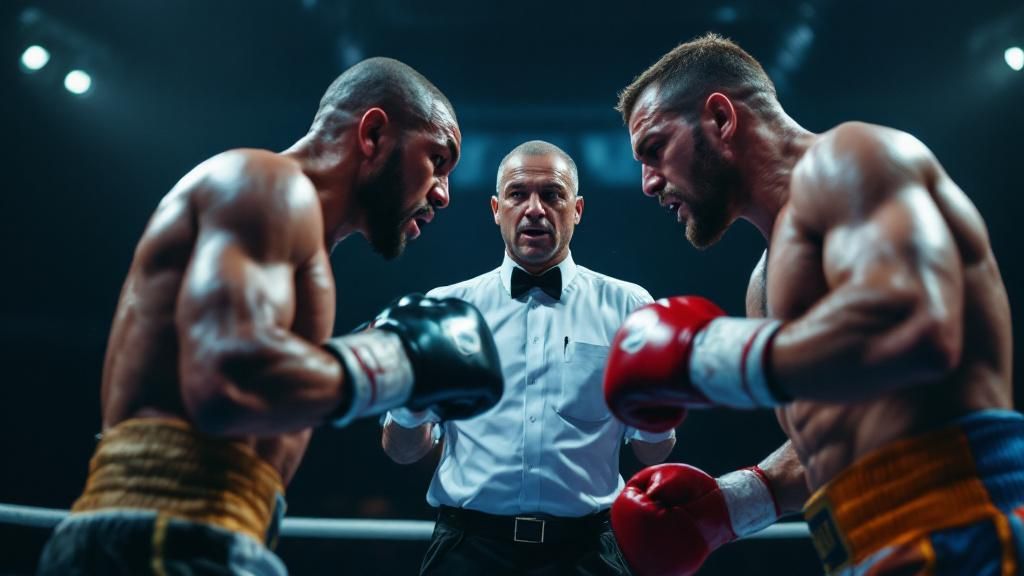
Phil Edwards has spent 30 years at the heart of professional boxing’s most intense moments, officiating countless bouts including world title fights featuring Anthony Joshua, Savannah Marshall and Josh Warrington. Yet the Preston-born Welshman, now 70 and no longer undertaking in-ring duties but still working as a judge, rarely speaks publicly about his experiences. His role as a professional boxing referee is far from glamorous, despite offering what some might regard as the best seat in the house. Instead, it requires complete concentration and split-second decision-making in a sport where life-changing injuries can occur without warning. Edwards has recently spoken out about the considerable strain that comes with serving as the referee in the ring—the official responsible for keeping fighters safe when everything happens at breakneck pace.
The Burden of Accountability
Edwards is adamant about the central objective of his role: protecting boxer welfare above all else. In a sport where head injuries, lacerations and brutal knockdowns are common events, the referee’s watchfulness can mean the difference between a fighter returning to their loved ones or suffering catastrophic injury. “The most important part of the job is doing whatever possible to ensure the safety of the boxers,” Edwards underlined. This responsibility weighs heavily, demanding total focus throughout all rounds. There is no margin for error, no moment where attention can lapse without possibly serious repercussions unfolding before large crowds.
The rigour of this role should not be underestimated. Edwards portrays the experience as at once satisfying and demanding—a paradox intrinsic to professional arbitration. The distinction of working ringside with elite athletes is counterbalanced by the constant psychological pressure. “You have to be entirely concentrated,” he explained. Referees need to foresee danger before it happens, evaluate unclear moments in real time, and make irreversible decisions that can impact futures and reputations. The job offers no rehearsals, no opportunities to review footage and reconsider. Every choice is irreversible, every judgment binding.
- Monitor competitor welfare and physical condition across the full duration of the match
- Enforce rules impartially while preserving control of the contest
- Take instantaneous judgements under immense pressure and scrutiny
- Maintain complete attention for every second of action
Addressing Scrutiny from the Public and Critical Feedback
Negative feedback is part of the job for boxing referees, particularly when their calls prove contentious. Whether halting proceedings ahead of schedule, overlooking rule violations, or letting bouts proceed longer than some believe appropriate, officials face unrelenting examination from fans, commentators and stakeholders alike. Edwards acknowledges this fact with customary practicality, viewing criticism as a necessary outcome of the role. “There are situations where you get criticism and certain things are regarded as, if you like, ‘controversial’,” he observed. Whilst some criticism is justified and serves to preserve professional integrity, the severity and nature of modern condemnation often exceeds proportionate levels, particularly in online forums where namelessness encourages harsh judgment.
The distinction between responsible oversight and unwarranted abuse remains vital. News organisations and boxing authorities have a legitimate obligation to question decisions and guarantee that officials uphold rigorous benchmarks. However, this must be balanced against the reality that referees work within intense demands, consistently placing fighter welfare over public favour. Edwards has adopted a measured perspective over the course of his career, accepting criticism as part of the job rather than allowing it to undermine his confidence or decision-making. This resilience is necessary for anyone pursuing a career in boxing officiation, where every choice—however carefully considered—will inevitably displease someone.
Digital Platforms and the Contemporary Challenge
The introduction of social media has fundamentally reshaped how criticism gets to boxing officials. In past years, referees might hear about negative reactions through slow-moving press coverage or personal recommendation. Today, they face real-time, uncensored opinions from large audiences, often expressed in harsh criticism. This democratisation of criticism, whilst sometimes providing genuine insight, often devolves into personal attacks that show scant relevance to the true standard of officiating. Edwards’ generation of referees built resilience through conventional means; modern officials must contend with an completely transformed environment where their rulings are analysed, ridiculed and attacked in live time across multiple platforms.
The psychological effect of relentless digital criticism is substantial. Young referees entering the profession today face an environment vastly significantly more adversarial than their predecessors faced. Anonymous social media users are encouraged to make accusations of bias or incompetence without evidence or accountability. Whilst seasoned referees like Edwards maintain perspective, acknowledging that strong disagreement is inherent to sport, younger referees may find difficult this unrelenting hostility. The challenge for regulatory authorities in boxing is protecting officials from excessive abuse whilst preserving legitimate mechanisms for accountability and development in a time when every ruling is rapidly disseminated to millions.
- Instant online criticism gets to officials right following decisions
- Unnamed social media users regularly express severe criticism without accountability
- Balancing valid oversight against defence from unjustified personal criticism proves challenging
Safety First: Reading the Ring
At the core of every referee’s responsibility lies an unwavering commitment to fighter safety. The ring is an demanding setting where split-second decisions can determine whether a bout continues or is stopped to prevent significant harm. Referees must demonstrate an almost preternatural capacity to evaluate a fighter’s state—their stability, their reflexes, their cognitive sharpness—whilst simultaneously monitoring the action unfolding at close range. Edwards emphasises that this safeguarding function takes precedence over all remaining factors, including the wishes of promoters, audiences or even the fighters themselves. A referee who allows a bout to continue when a fighter is truly impaired risks catastrophic consequences that extend far beyond the evening’s entertainment.
The responsibility rests heavily because the consequences of poor judgement can be life-altering. A early stoppage disappoints fans and fighters alike, but an excessively permissive stance can lead to concussions, neurological damage or worse. Referees must weigh compassion against firmness, understanding that their role demands they sometimes shield fighters from their own desire to keep fighting. Edwards recalls situations where fighters have protested his decisions to end fights, only to later acknowledge that his decision prevented serious harm. This vindication seldom reaches the public consciousness; instead, referees recall the instances of uncertainty, the fraction-of-a-second judgements made under significant pressure where the difference between sensible caution and premature stoppage measured just millimetres.
Cultivating Referee Instinct
Experienced referees acquire an nearly intuitive understanding of when danger is imminent, developed via hundreds of hours observing fighters in different degrees of difficulty. This instinct can’t be imparted through textbooks or classroom settings alone; it arises out of continuous involvement to the finer points, from recognising the subtle signs that distinguish a weary competitor from a truly hurt one. Edwards’ 30 years in the sport have equipped him with an comprehensive understanding of how different boxers deal with adversity, how their footwork shifts and their eyes betray weakness. Inexperienced officials must work with seasoned guides, steadily constructing this intuitive knowledge base that ultimately becomes their greatest strength.
Technology and Tradition: The VAR Debate
The question of whether boxing should adopt technological assistance—akin to VAR in football—remains disputed within the sport. Proponents argue that frame-by-frame analysis could resolve controversial decisions, particularly regarding fouls, knockdowns and the specific point a referee should intervene. However, boxing differs substantially from football; the referee’s on-the-spot judgement of a fighter’s condition cannot be adequately reproduced by cameras. Edwards accepts the appeal of technology but highlights that boxing’s immediacy demands instantaneous human judgement. A suspended call whilst reviewing footage could prove catastrophic if a genuinely compromised boxer continues fighting during the review period.
The sport’s regulatory authorities have resisted wholesale technological integration, choosing to improve rather than replace manual decision-making by officials. Video review for judging assessments in professional bouts has achieved modest recognition, allowing judges to reconsider marginal decisions between rounds. Yet implementing automated systems for bout termination calls raises moral concerns; the official must assess not merely what happened, but the fighter’s neurological state and capacity to continue safely. Edwards argues that the sport’s established practice of trusting experienced officials demonstrates a more profound comprehension of the sport’s unique demands. Equipment functions most effectively as a supplementary tool for after-match review and skill development, rather than as a live adjudication system that could compromise the referee’s protective authority.
| Technology | Application in Boxing |
|---|---|
| Video Review | Post-round scorecards and knockdown verification between rounds |
| Slow-Motion Replay | Analysing controversial decisions and fouls for training purposes |
| Real-Time Monitoring | Wearable sensors tracking fighter biometrics during bouts |
| Live Stoppage Review | Pausing action to assess fighter condition—currently rejected due to safety concerns |
The Direction of Boxing referees and judges
The landscape of boxing officiating encounters considerable change as the sport navigates modernisation whilst maintaining its conventional integrity. Younger officials are entering the profession with new viewpoints, yet they assume the same essential obligation as their earlier counterparts: ensuring fighter welfare above all else. Educational programmes have become progressively stringent, with candidates undergoing thorough training on neurological testing, current rulebooks and conflict management. The British Boxing Board of Control continues refining its benchmarks, acknowledging that audience trust in the sport rests on officials who gain authority through competence and impartiality. Edwards believes the next generation must maintain steadfast dedication to these standards.
Recruitment remains a ongoing challenge for boxing’s regulatory authorities. The challenging character of the role, combined with inevitable criticism from stakeholders and social media, discourages many potential candidates. However, those who persevere find genuine fulfilment in supporting the sport’s standards. Mentoring schemes pairing experienced officials with new entrants have proven invaluable, enabling sharing of expertise and maintenance of traditions within the refereeing and judging fraternity. As boxing continues attracting worldwide viewers and financial backing, the standard of officiating performance becomes increasingly vital. Edwards stresses that attracting dedicated individuals prepared to place boxer welfare first over popularity represents boxing’s most significant hurdle going ahead.
- Strengthened mental health support for officials handling complex officiating decisions
- Standardised international training protocols ensuring consistency across multiple regulatory bodies
- Greater openness regarding disputed rulings by means of post-fight press conferences and review
- Professional progression routes facilitating movement from amateur to professional officiating roles
